

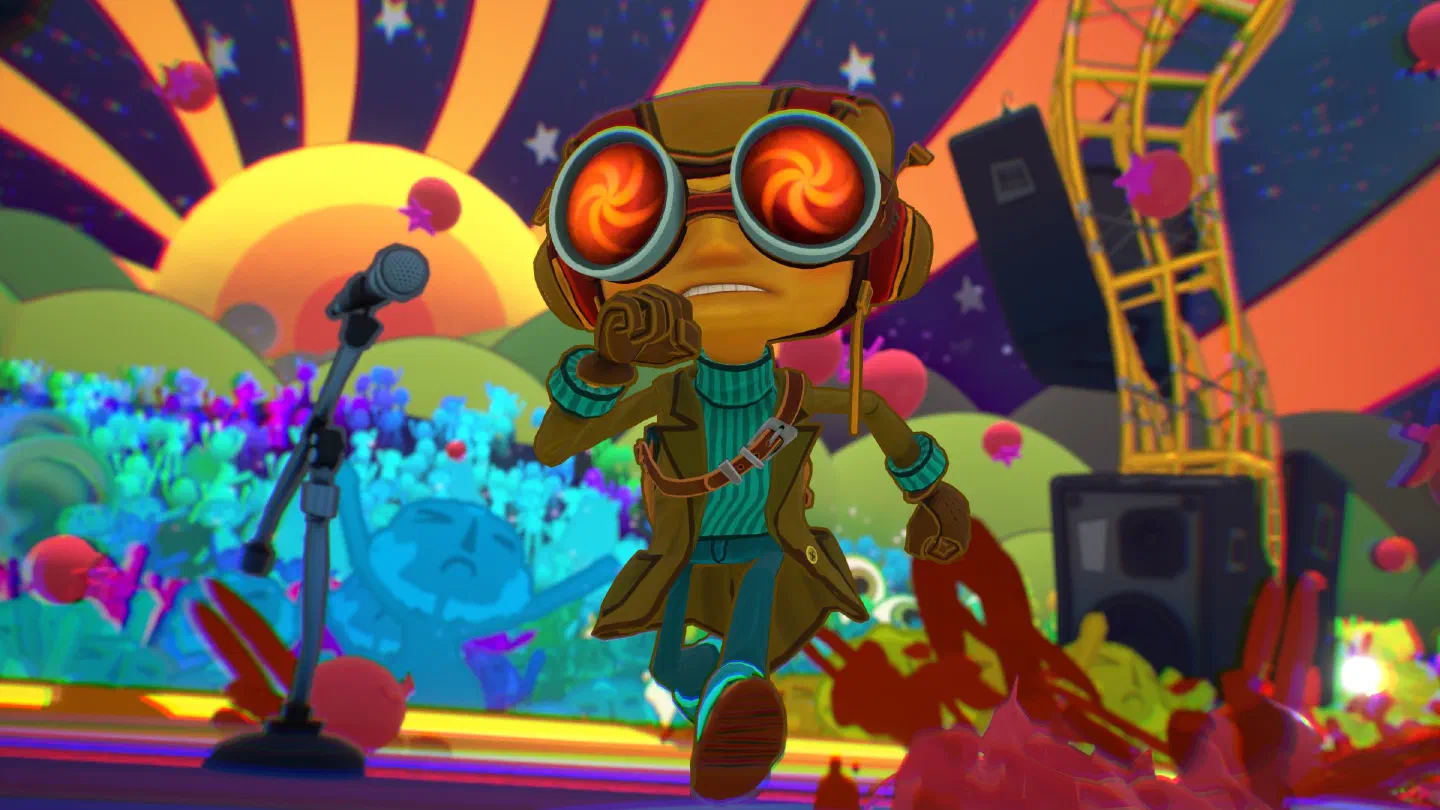
Do you like hearing about Freud? About psychoanalysis, and classic concepts like the ego, the id, and the superego? Do Carl Jung’s theories about archetypes catch your interest? What about psychological treatments, like CBT? Do you enjoy learning about those? If you like studying or watching films and reading novels that explore the inner world of human beings, and now you want to experience those themes in the world of video games, then I think I have a suggestion for you. The game is called Psychonauts 2.
First, let me talk about the brain behind the game, Tim Schafer. When he started out, he made games as a programmer at LucasArts. If you’re a fan of the Star Wars universe, you’ll remember that Star Wars was directed by George Lucas, and George Lucas is also the person who founded LucasArts. Back to Tim Schafer: after an amount of time working in LucasArts company, he left the company and collaborated with a few colleagues (also from LucasArts) to found Double Fine Studio. Their debut was Psychonauts 1 (released in 2005). The game was a cult classic (*), highly praised, but unfortunately its revenue didn’t match its reputation. Fifteen years later, Double Fine released Psychonauts 2, and once again the game proved itself a masterpiece. Right now, you can check its score in the Steam reviews and see the game be scored as “Overwhelmingly Positive”.
One curious thing is that despite its success, the money it brought the studio, and its prestigious nominations, I feel the game isn’t… all that famous. In the year Psychonauts 2 came out, its closest rival was “It Takes Two”, and “It Takes Two” was loved by a lot of people. Try searching YouTube for Vietnamese videos about It Takes Two, for example, and you won’t have trouble finding content about it. But search for Psychonauts 2 and you’ll find it doesn’t seem to get talked about nearly as much. In Vietnam, at a glance, nobody has made a video about Psychonauts 2 at all. So, as someone who finished the game not long ago, I feel I should share a few words about a game that, to me, is really, really outstanding.
To begin with, the story of Psychonauts 2 takes place in a world where some people have psychic powers. They are called “Psychonauts”. Sometimes these powers are as simple as making fire or moving objects, or as advanced as freezing time. If that were all, they’d be little more than wizards. But what makes Psychonauts special is that they can enter other people’s “minds”. Sometimes, psychonauts enter human psyche to protect, sometimes to heal, and sometimes for intelligence work. The job of our main character, and the core mission throughout the whole game, is to play a kind of psychologist. For most of the game, the protagonist jumps into the mental worlds of other characters and tries to resolve their psychological troubles.
Of course, since this is a video game, being a psychologist doesn’t mean you’ll sit and talk with characters the way Carl Rogers would. Instead, the game portrays mental issues in two ways. The first is through the environment. The second is through the monsters, the enemies the player has to face. Each enemy you fight represents a shade of feeling, a symptom that happens to everyone. For example, say you get scolded by your boss at work today and you’re in a bad mood. Well, in the game there are “Bad Mood” enemies who throw bombs at you. Or sometimes you feel regret, then in the game regret exists as a winged creature struggling to carry a heavy weight beneath it. That’s how it goes: every kind of emotion and mental state is embodied in the game as a creature the player has to face.
However, the best thing about Psychonauts 2 lies in its world building and level design. As I mentioned, the main theme of the game revolves around the human inner world, and the inner world of people is full of endless colors and forms. So the levels in Psychonauts 2 are almost never bound to any one theme. It might be a world inspired by a casino, a cooking competition like MasterChef, or a post-apocalyptic dimension set among bowling alleys. In short, the level design in Psychonauts 2 is incredibly creative.
And in fact, this is something Psychonauts 2 and It Takes Two have in common. Not every 3D platformer gets this kind of creative freedom. For example, I’ve played Kao the Kangaroo, Ratchet & Clank, and a few others. In my opinion, because the settings are so open, there is no limit of themes or world building for each platforming stage. Hence, Psychonauts 2 and It Takes Two do this extremely well in terms of level creativity. One great thing about Psychonauts 2 is that since the game takes place inside people’s minds, the setting of each level also reflects that mental world. For example, one level I really loved was about a character struggling with alcoholism. In that world, everywhere you look in the level, there’s water. As if the character were using alcohol to drown their inner problems.
A very good way to describe Psychonauts 2 comes from a very well-known YouTuber, Skill Up. He called Psychonauts 2 “The Simpsons” of the gaming world. What does that mean? If you don’t know, “The Simpsons” is an American animated TV series, famous because each episode is made so that both adults and kids find it enjoyable. Kids understand it in their own innocent way, while adults have their own reading of it. Psychonauts 2 is the same: both kids and adults will come away with their own understanding as they play. Beyond its cartoony, cute graphics, Psychonauts 2 clearly include very serious theme, for example are war, guilt, love, abandonment, and so on. So, the game tone is, frankly, somewhat darker and more mature than It Takes Two.
Finally, let’s talk a bit about the game’s structure. Although the game doesn’t call itself open world, it still has a Hub Area (roughly: a central area that connects to the other regions). Because of this, for about two-thirds of the playtime you don’t feel like you’re on a linear adventure. Instead, the player always feels free to choose what to do first and what to do later. One commendable thing about this Hub Area is its quality. I never felt bored exploring it, and it feels like every nook and cranny holds a secret waiting to be unlocked.
In short, Psychonauts 2 is, to me, a masterpiece, a classic game for all ages. It isn’t a long game either; around 20 hours is enough to experience it fully. The game also goes on sale from time to time. In Vietnam you can sometimes pick it up for just 100,000 VND!
Overall experience: 9.5/10!
(*) Cult classic: The English word “cult” is commonly used to mean a small religion, or a small group of sect members and followers. In the case of films, stories, and other entertainment works, the word usually refers to works that aren’t hugely famous among the general public but are loved by a small, loyal audience. Examples of cult films include Cloud Atlas and Fight Club (which started out as a cult film but became famous and gradually more familiar to the general public).
Credits
Header image from: https://wallpapercave.com/w/wp9711227
Comments